AI Search Monitoring for Agencies
Check what AI engines and the web say about your brand
AI search monitoring for agencies means running each client's buyer prompts on ChatGPT, Gemini, Perplexity, Claude and Google AI Overviews every week, recording whether the client is mentioned, recommended and cited, and turning that into a short white label report that sits next to the SEO and PR numbers clients already receive.
Clients are starting to ask a new question in quarterly reviews: "what does ChatGPT say about us". Agencies that can answer it with data, rather than a screenshot someone took that morning, have a clear advantage when renewals come round. This guide covers how to set up AI search visibility monitoring across a client roster, what to put in the report, how to price it, and how to avoid the traps that make AI reporting look flimsy.
Why clients now expect AI visibility reporting
For years the agency report had a familiar shape: rankings, organic traffic, coverage, backlinks, social engagement. Each of those maps to a channel the client can see. AI answers are different. The client's prospects ask an assistant for recommendations, receive a short list and often act on it without visiting any site. The client cannot see that conversation, and neither can their analytics.
That creates both a worry and an opportunity. The worry is that a competitor is being recommended in answers the client never sees. The opportunity is that the agency becomes the team that makes this channel visible and measurable. For SEO and PR agencies especially, AI visibility is a natural extension of existing work, because the sources AI engines cite are the same articles, reviews and community threads those agencies already influence.
Setting up monitoring for a client roster
The mechanics are the same as for a single brand, repeated per client with discipline. What changes at agency scale is organisation.
One workspace per client
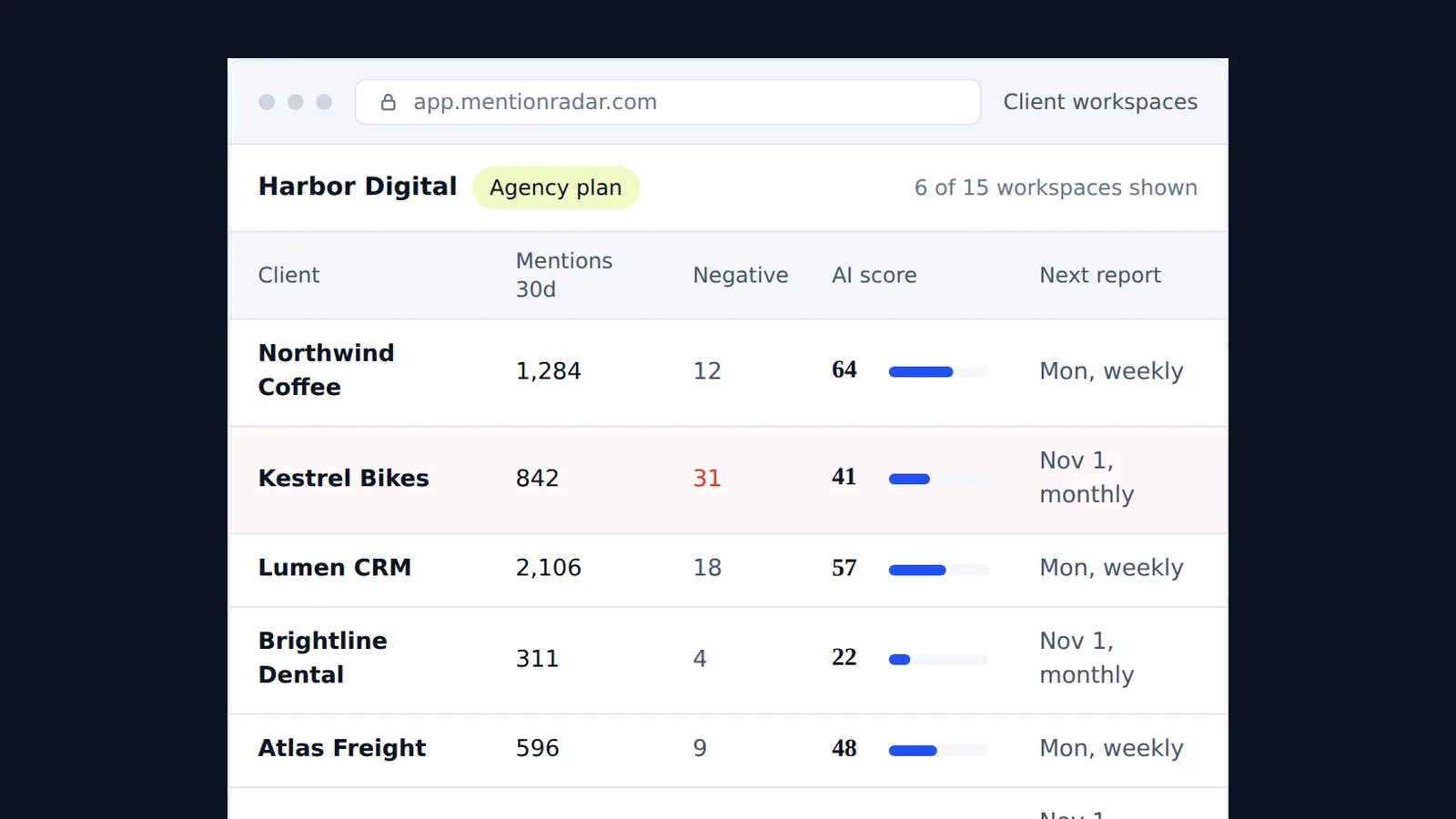
Keep each client's keywords, competitors, prompts and alerts separate. Mixing clients in one project makes reporting error prone and makes it impossible to give a client read only access to their own data. Our Agency plan includes 15 client workspaces with separate limits, described on the page about reputation management software for agencies.
A prompt set per client, agreed with the client
Draft ten to twenty prompts per client, mostly unbranded category questions their buyers ask, plus a few comparison prompts naming the competitors they lose deals to. Then review the list with the client. This is worth the meeting: it surfaces how the client actually thinks about their market and it gives them ownership of the metric. When a score moves later, nobody argues about whether the prompts were the right ones.
Consistent engines and schedule
Run every client's prompts on the same engines, on the same weekday, from the same region. Comparability across weeks matters more than covering every possible engine. ChatGPT, Perplexity and Google AI Overviews are a reasonable minimum. Adding Gemini and Claude gives fuller coverage for clients whose buyers use them.
Competitors tracked with equal rigour
An AI visibility number on its own invites the question "is that good". The answer is always relative. Track three to ten named competitors per client on the same prompts so you can report AI share of voice. The competitor monitoring tool page explains how competitor tracking works in practice.
What to include in the client report
Clients do not want thirty AI answers pasted into a document. They want to know where they stand, what changed and what you are doing about it. A one page section works well.
- Headline score and trend. The AI visibility score for the month, with the previous three months for context. If you need a refresher on how the score is built, see what an AI brand visibility score measures.
- Per engine breakdown. A small table showing presence and recommendation rate in each engine, because movement often happens in one engine first.
- AI share of voice versus competitors. One bar chart. This is usually the chart clients forward to their leadership.
- Prompts won and lost. Two or three prompts where the client improved and two or three where a competitor overtook them, with a one line explanation each.
- Top cited sources. The domains engines rely on for this client's category. This links the AI section to your PR and SEO work.
- Actions for next month. Specific, tied to the findings. "Pitch updated pricing to the two comparison articles Perplexity cites most" is a good action. "Improve AI visibility" is not.
Put the agency's branding, or the client's, on the report rather than the tool's. White label PDFs with the client logo and your sender name keep the relationship where it belongs. Scheduled monthly delivery means the report goes out even in a busy week.
Connecting AI findings to work the agency already sells
The strongest agency reports show cause and effect. AI monitoring makes that possible because cited URLs point straight at work you can do.
- PR agencies can target the publications engines cite most for the client's category, then show the client appearing in answers after coverage lands. Pair this with media monitoring software to track the coverage itself.
- SEO agencies can create or improve pages that answer category questions directly, fix inconsistent facts across the client's site and listings, and track whether the client's own domain starts being cited. Our LLM SEO tool page goes deeper on this.
- Social and community agencies can monitor the Reddit threads and forums engines quote, respond where appropriate, and flag reputation risks before they harden into AI answers.
When the report shows "we secured inclusion in the two articles Perplexity cites for your top prompt, and your recommendation rate in Perplexity rose over the following weeks", the client understands what they are paying for.
Pricing AI visibility as an agency service
There are three common approaches, and the right one depends on how the agency already charges.
Included in an existing retainer
Adding an AI section to an SEO or PR retainer is the fastest way to start and a strong retention tool. The cost of tooling spread across a roster is usually small relative to a retainer.
A separate monitoring add on
A fixed monthly fee for weekly AI and web monitoring plus a monthly report. This works well when clients buy services à la carte and makes the value visible on the invoice.
Part of a larger visibility programme
Some agencies package AI monitoring with content and digital PR into a programme with a clear goal, such as improving recommendation rate on a defined prompt set. This is the most valuable offer but needs a few months of baseline data to set realistic expectations.
Whichever model you choose, avoid promising specific positions in AI answers. Answer engines change their behaviour often and no agency controls them. Promise measurement, clear reporting and steady work on the sources, which you can deliver.
Traps that make AI reporting look weak
- Screenshot reporting. A single screenshot proves nothing, because the next run may look different. Report rates across repeated runs.
- Changing the prompt set every month. It destroys trend lines. Change it quarterly at most and note the change in the report.
- Only branded prompts. Scores look great and mean little. Clients eventually notice.
- No competitors. Without competitive context, every number is hard to interpret.
- Separate tools for web and AI. Reconciling two exports per client every month is where agency margins go. A combined dashboard keeps it to one workflow.
- Seat limits that block account managers. Each account manager should be able to open their clients' workspaces without sharing a login.
Running the review meeting
The report is only half of the value. The other half is the conversation in the monthly or quarterly review. A few habits make the AI section land well.
Start with the competitive picture
Open with AI share of voice against the competitors the client named during onboarding. Clients care about relative position far more than absolute scores, and it frames everything that follows.
Show one real answer, labelled as an example
After the numbers, show one actual answer from the latest run for the client's most important prompt, with their brand and competitors highlighted. Say clearly that it is one example of many runs. A real answer makes the data tangible without letting a single screenshot carry the argument.
Tie every action to a cited source
When you propose next month's work, point to the specific article, review page or thread the engines cite. Clients approve concrete work faster than abstract goals, and it gives you a clear test of whether the work had an effect.
Flag reputation risks separately
If an engine repeats a criticism or an outdated fact, give it its own line in the meeting. Clients want to hear about risks from their agency first, not discover them when a prospect mentions it on a sales call. Pair it with the web mention that started it, found through reputation monitoring software.
Operational tips for account teams
- Template everything. One prompt drafting template, one report template, one alert rule set per client type. Consistency is what makes agency scale possible.
- Route alerts to client specific Slack channels. Negative or high reach mentions should reach the account manager responsible for that client, not a shared inbox.
- Use roles. Give editors access to configure prompts and viewers access to read, so juniors can prepare reports without changing a client's setup by accident.
- Keep a change log per client. Note prompt changes, launches and major coverage, so trends can be explained months later.
A rollout plan for the first ninety days
Days 1 to 14. Pick three clients who already ask about AI. Set up workspaces, agree prompt sets, add competitors, start weekly runs.
Days 15 to 45. Add a draft AI section to their monthly reports. Collect feedback on what they found useful. Refine the template.
Days 46 to 90. Roll the template out to the rest of the roster, decide on pricing, and train account managers to explain the score and the actions in review meetings.
By the end of the quarter, every client report has an AI section built on three months of data, which is enough to show real trends. To see how a client would look today, run a scan of their brand from our homepage, or compare the Agency plan with white label reports on the pricing page.
Frequently asked questions
What is AI search monitoring?
It is the regular tracking of how AI engines such as ChatGPT, Gemini, Perplexity, Claude and Google AI Overviews answer the questions a brand's buyers ask, including whether the brand is mentioned, recommended and cited.
How many prompts should an agency track per client?
Ten to twenty prompts per client is a practical range. It is enough for a stable trend and small enough to review with the client. Larger clients with several product lines may need more.
Can clients see their own AI visibility data?
With separate client workspaces and read only access, clients can view their own dashboards without seeing other clients or editing settings. Many agencies prefer to share a monthly white label report instead.
Should agencies promise better positions in AI answers?
No. AI engines change their behaviour frequently and nobody controls their answers. Agencies can promise consistent measurement, clear reporting and work on the sources engines cite.
How does AI visibility relate to PR and SEO work?
Closely. AI engines cite articles, reviews and community threads, which are the same sources PR and SEO agencies already work on. Cited URL data shows exactly which sources to prioritise.