What an AI Brand Visibility Score Measures
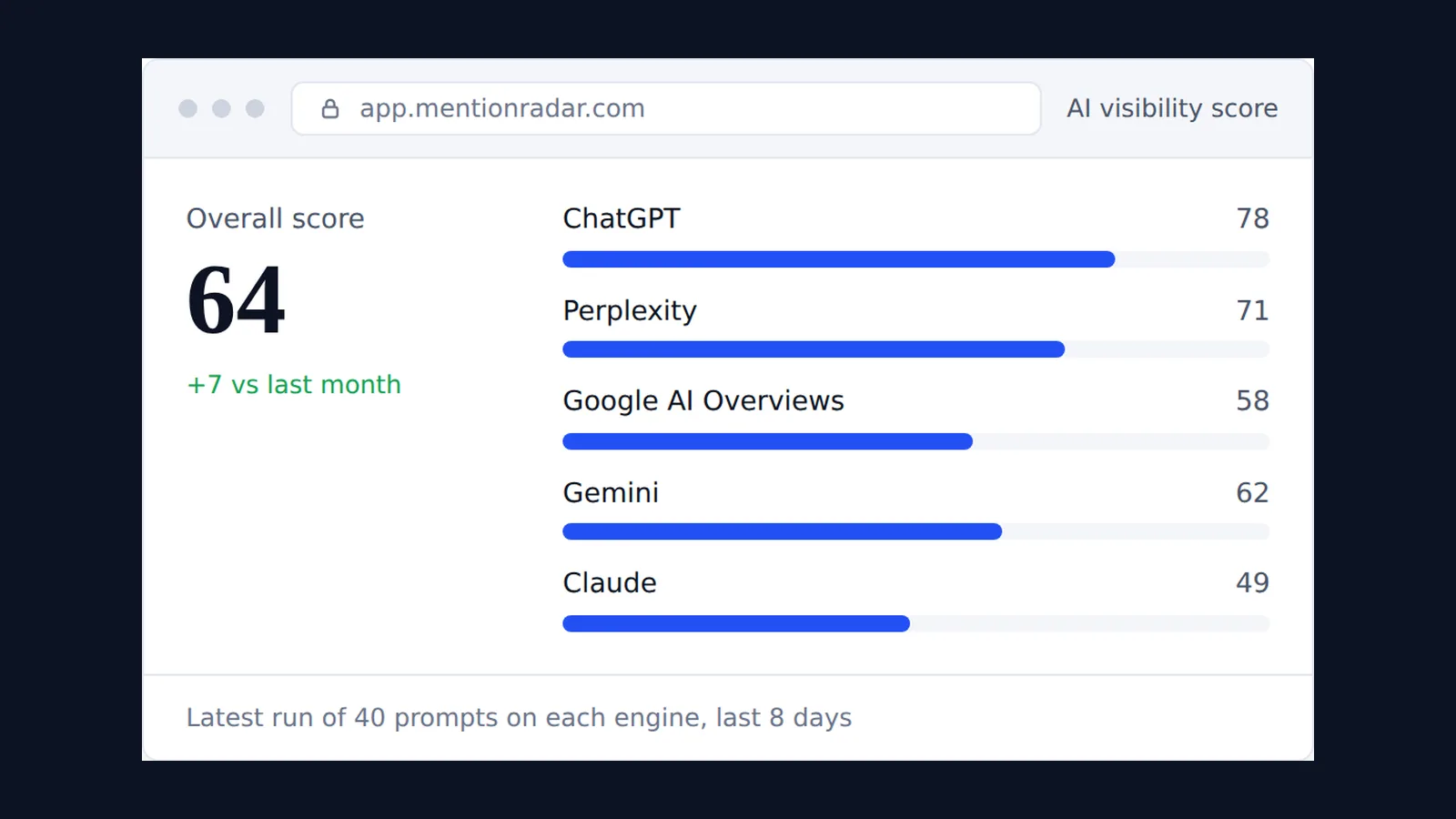
Check what AI engines and the web say about your brand
An AI brand visibility score measures how often, how prominently and how favourably AI engines such as ChatGPT, Gemini and Perplexity mention your brand across a fixed set of buyer prompts. You raise it by earning accurate inclusion in the sources those engines cite and by publishing pages that answer category questions plainly.
The idea of a single score is appealing because AI answers are messy. Dozens of prompts, several engines, answers that change from week to week. A score turns that into one number that can sit next to organic traffic and pipeline in a leadership report. The risk is that a number without a clear definition becomes a vanity metric. This article explains what goes into a well built AI search visibility score, how to read it, its limitations, and the practical levers that move it.
The components of a visibility score
Different tools weight things differently, but a credible score is built from the same handful of signals, each measured per prompt and per engine, then averaged across the prompt set.
Presence
Does the brand appear in the answer at all. This is the foundation. If you are absent from most category answers, nothing else in the score matters much.
Position
Where in the answer the brand appears. Many answers list several products. Being named first or second carries more weight than being named fifth, both because readers skim and because engines tend to put their strongest recommendation first.
Recommendation strength
Whether the engine actively recommends you or merely lists you. "For most mid sized teams, X is the strongest option" is a recommendation. "Other tools include X, Y and Z" is a mention. A good score distinguishes the two.
Sentiment of the description
How the engine characterises the brand. Neutral factual descriptions are common. Phrases such as "known for reliability issues" or "expensive for what it offers" pull the score down even when presence is high.
Citation of your own domain
Whether the engine links to your site as a source. When an engine cites your pricing or documentation page, it is drawing facts directly from you, which usually means more accurate descriptions.
How the components combine
A simple and transparent approach looks like this. For each prompt run, give points for presence, add points for position (more for first, fewer for later), add points if recommended, adjust for sentiment, and add a small amount if your domain is cited. Normalise the result to a scale of 0 to 100. Average across all prompts and engines for the period.
| Signal | A strong result looks like | A weak result looks like |
|---|---|---|
| Presence | Named in most category answers | Named only when the prompt includes your brand |
| Position | Usually first or second | Usually last in a long list |
| Recommendation | Explicitly suggested for a use case | Listed without comment |
| Sentiment | Accurate, positive or neutral description | Outdated facts or repeated criticism |
| Own domain cited | Pricing or docs pages linked | Only third party pages linked |
Whatever the weighting, the important thing is that it stays constant. A score is only useful as a trend. Change the formula and you lose comparability with every previous week.
Why the prompt set matters more than the formula
The same brand can score 80 or 20 depending on which prompts are tracked. Track only branded questions ("what is Acme") and almost every brand scores well, because the engine has to talk about you. Track only broad category questions in a crowded market and almost every challenger scores poorly.
That is why a score should always be reported together with the prompt set it was measured on. Keep the set stable, add prompts deliberately, and if you make a large change to the set, restart the baseline. A healthy prompt set for most B2B brands is mostly unbranded category questions, plus some comparison and branded prompts. We describe how to build one in how to track brand mentions in ChatGPT, Gemini and Perplexity.
Score per engine versus blended score
A blended score across engines is convenient for headlines but hides important differences. Perplexity cites sources heavily and reacts quickly to new content. Answers built largely from trained knowledge change slowly. Google AI Overviews follow the classic index closely. A brand can improve sharply in one engine and stay flat in another for entirely sensible reasons.
Report the blended score, but always keep the per engine breakdown one click away. When the blended figure moves, the first question should be "which engine moved it".
Limitations to keep in mind
- Answers vary between runs. Small week to week movements are often noise. Look at four week trends before reacting.
- Location and language affect answers. A score measured in US English may not reflect what buyers in Germany see.
- Not every prompt is equally valuable. A prompt your best customers ask is worth more than a generic one. Some teams weight prompts by business value.
- The score is not traffic. Being recommended does not guarantee a click. Treat the score as a leading indicator of consideration, alongside pipeline and branded search.
How to raise an AI brand visibility score
There is no trick that reliably moves AI answers. What works is steady, factual work on the sources engines use and on your own pages. These are the levers, roughly in order of impact for most B2B brands.
Get included in the sources engines cite
Look at the cited URLs for your weakest prompts. They are typically comparison articles, best of lists, review site category pages and community threads. Accurate inclusion in those pages is often the single biggest lever. Approach editors with facts, not hype: what you do, who it is for, current pricing. Our AEO tool lists the domains cited most often for each tracked prompt.
Answer category questions on your own site
Engines that search the live web reward pages that answer a question directly. A page titled after the category ("brand monitoring for agencies"), with a direct answer in the first paragraph, clear headings, a comparison table and an FAQ, is easy for an engine to quote. Vague marketing pages are not.
Keep facts consistent everywhere
When your pricing page, your review site listings and your documentation disagree, engines pick one, often the outdated one. Audit the facts that matter (plans, prices, core features, integrations, who the product is for) and make them identical across every surface you control.
Earn genuine community discussion
Reddit, Hacker News and niche forums appear frequently among cited sources. You cannot fake this and should not try. You can participate honestly, answer questions where your product is relevant, and fix problems people raise publicly. Monitoring those communities is part of the job; see our social listening tool.
Address negative framing at its source
If engines repeat a criticism, trace it to the thread or review that started it. Fixing the issue and responding publicly does more than publishing counter content.
Use structured data and clear page structure
Organization, Product or SoftwareApplication and FAQ markup do not guarantee inclusion, but they make facts unambiguous for systems that read your pages. Clean headings and short factual paragraphs help both search engines and answer engines.
Reading the score alongside web share of voice
An AI visibility score tells you how answer engines see you. Web share of voice tells you how much of the conversation on news sites, forums and social platforms you own. The two usually move together with a lag. A rise in web coverage and community discussion tends to show up in AI answers some weeks later, especially in engines that search live. Watching both in one place lets you connect cause and effect. Our share of voice tool computes share across web mentions and AI answers together, and the method is explained in share of voice measurement across web and AI answers.
Three patterns we see when reading scores
Once a score has a few months of history, it usually falls into one of three shapes. Recognising the shape tells you where to spend effort.
High presence, low recommendation
The engines know you exist and list you, but rarely suggest you for a use case. This usually means your positioning is unclear in the sources they read. Reviews and comparison articles describe you generically ("another monitoring tool") rather than for a specific job ("best for agencies that need white label reports"). The fix is sharper positioning on your own pages and in the facts you give editors, repeated consistently until it shows up in descriptions.
Strong in one engine, absent in another
Often a brand does well in Perplexity, which leans on recent web sources, and poorly in answers built from trained knowledge, or the reverse for long established brands. Neither is a failure. It tells you that recent work is landing on the live web and has not yet reached the slower channel, or that your historical reputation is strong while recent coverage is thin. Plan accordingly and give slower engines more time.
Score falls while web coverage grows
This happens when new coverage lands on sources engines do not cite, or when a competitor gains inclusion in a heavily cited article. Compare the cited domains this month against last month. A single change in an influential comparison page explains more score movements than any other factor we see.
What a score should never be used for
A visibility score is a planning and monitoring tool. It should not be used to judge an individual's performance week to week, to promise clients a guaranteed figure, or to compare brands measured on different prompt sets. Each of those uses pushes people to game the prompt list instead of improving the brand's real presence in the sources buyers and engines read.
A sensible reporting rhythm
Weekly runs, a monthly review, and a quarterly look at the prompt set works for most teams. In the monthly review, report the blended score and per engine scores, the three prompts that improved most and the three that declined, the top cited domains, and one or two actions for the next month. Keep it to a page. If you would like to see a first score for your brand, run a scan from our homepage; plans with weekly tracking across all five engines are on the pricing page.
Frequently asked questions
What is a good AI visibility score?
There is no universal benchmark, because the score depends heavily on the prompt set and the market. Compare yourself against your own baseline and against competitors measured on the same prompts, rather than against an absolute number.
How often does an AI visibility score change?
Scores move a little every week because answers vary between runs. Meaningful changes usually appear over four or more weeks, after new coverage, content changes or shifts in the sources engines cite.
Is AI visibility the same as SEO ranking?
No. Classic rankings measure position in a list of links. AI visibility measures whether an engine names and recommends you inside a generated answer. They are related, since many engines search the web, but a brand can rank well and still be left out of AI answers.
Can I improve my score by publishing more content?
Volume alone rarely helps. Clear pages that answer specific category questions, consistent facts across the web and inclusion in the sources engines already cite are far more effective than publishing more articles.
Should the score be weighted by engine?
Some teams weight engines by how much their buyers use them. Whatever you choose, keep the weighting fixed over time and always show the per engine breakdown next to the blended figure.