Share of Voice Measurement Across Web and AI
Check what AI engines and the web say about your brand
Share of voice measurement compares how much of the conversation in your market mentions your brand versus named competitors. Across web and AI answers, you count brand mentions on news, forums, Reddit and review sites plus brand appearances in AI engine answers, then divide your total by the total for all tracked brands.
Share of voice is one of the oldest metrics in marketing. It started as a measure of advertising spend, moved to media coverage, then to social mentions. Each time the channel changed, the method had to change with it. AI answers are the newest channel, and most share of voice reports still ignore them. This guide explains how to measure share of voice properly in both places, how to weight what you count, how to combine the two into a single view, and how to use the result.
What share of voice actually tells you
Share of voice is a relative metric. It does not tell you whether people like you or how many leads you will get. It tells you how much of your market's attention you hold compared with the competitors you care about, and whether that share is growing or shrinking. Over time, share of voice tends to lead share of market: brands that hold more of the conversation usually find it easier to grow. That makes it useful as an early signal, provided it is measured consistently.
For B2B companies the competitive set is small and specific. You are not competing with every brand that gets mentioned online. You are competing with the five to ten products that appear in the same evaluations. Measuring against that set keeps the metric meaningful.
Web share of voice
Define the competitive set and the queries
List the competitors you lose deals to and the ones that appear next to you in reviews and comparison articles. For each brand, write a query that captures genuine mentions and excludes noise. Brand names that are common words need context terms and exclusions. Use the same level of query care for every brand, otherwise you measure your query skill rather than the market.
Choose the sources
Count mentions on the channels your buyers use: industry news, blogs, Reddit, Hacker News, forums, review sites, YouTube and X. Keep the source list identical for all brands. If you add a source, add it for everyone, and note the change in your reporting.
Count and weight
The simplest version counts mentions. That is easy to explain but treats a passing mention in a list the same as a detailed review. Two common refinements help.
- Reach weighting. Weight each mention by an estimate of its audience, so a story on a major industry site counts for more than a comment on a small forum. Use reach for sorting and weighting, and be cautious about reporting it as an absolute audience figure.
- Sentiment split. Report positive, neutral and negative share separately. A competitor with a spike in share of voice driven by an outage is not winning. Our social sentiment tracking page explains how sentiment is scored on each mention.
AI answer share of voice
AI share of voice uses the same logic on a different kind of data. Instead of mentions found on the web, you count brand appearances in answers to a fixed set of prompts run on AI engines.
Build a prompt set
Write the questions your buyers ask when looking for a solution, mostly without your brand name in them. "What is the best tool for monitoring brand mentions on Reddit." "Which platforms help agencies report AI visibility." Add a few comparison prompts. Keep the set stable. Our guide to tracking brand mentions in ChatGPT, Gemini and Perplexity covers prompt writing in detail.
Run on several engines
Run every prompt on ChatGPT, Perplexity, Google AI Overviews and, ideally, Gemini and Claude, on a weekly schedule. Answers vary between runs, so repeated runs matter more than any single answer.
Count appearances and weight by position
For each answer, record every brand named. Count one appearance per brand per answer. Optionally weight by position, giving more credit for being named first, and add extra weight when the engine explicitly recommends a brand. AI share of voice is then your weighted appearances divided by the weighted appearances of all tracked brands.
Combining web and AI into one view
Reporting two separate share of voice numbers is fine, and often useful. Many teams also want one blended figure for leadership. There are two reasonable ways to blend.
| Method | How it works | When to use it |
|---|---|---|
| Fixed weighting | Combine web share and AI share with fixed weights, for example equal weight to each | When you want a simple, stable headline figure |
| Buyer journey weighting | Weight each channel by how much your buyers rely on it in research, based on surveys or sales feedback | When you have evidence about where buyers research |
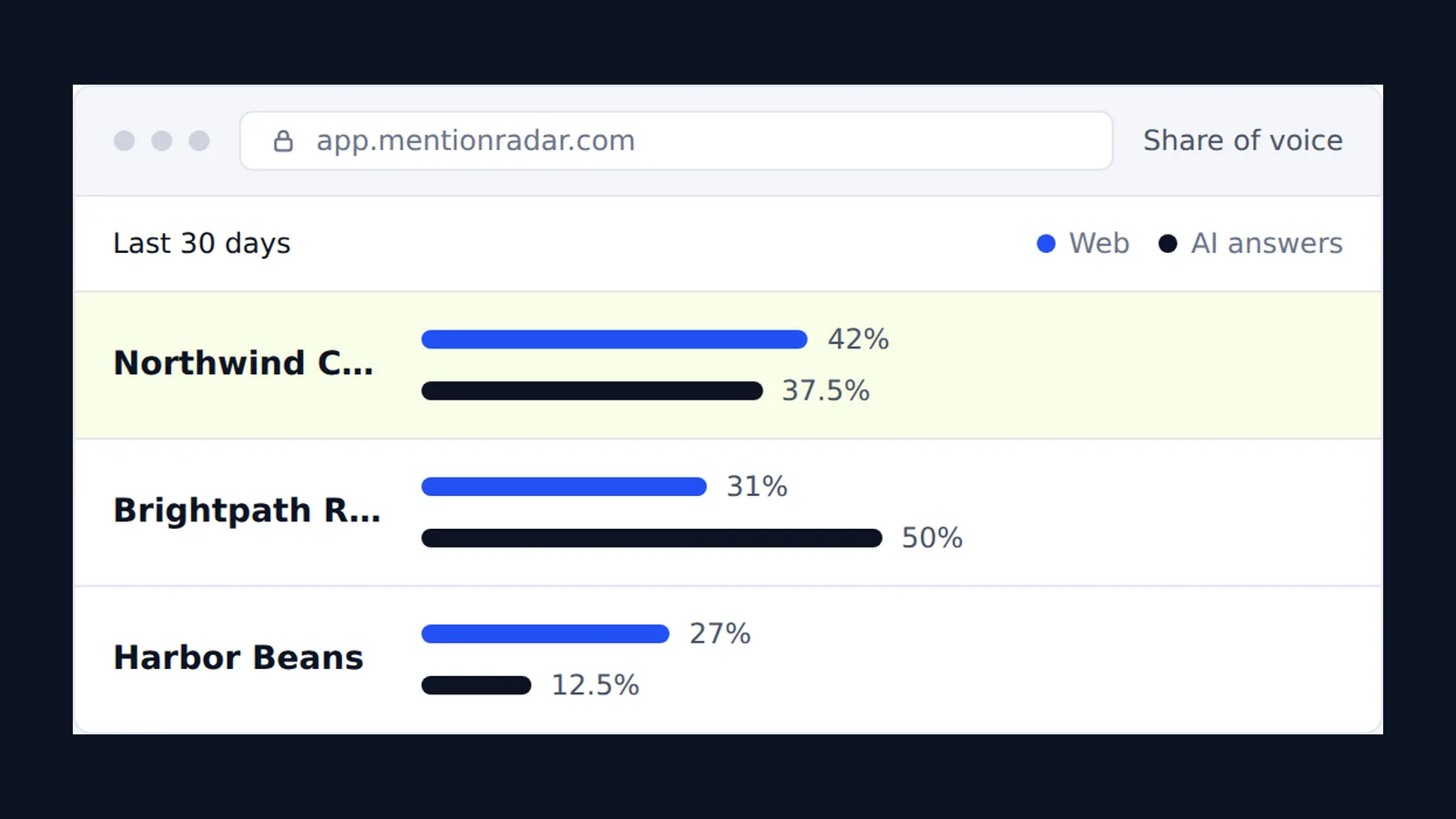
Whichever method you choose, keep it fixed, and always show the two components next to the blended figure. The interesting stories are usually in the gap between them. A brand with high web share and low AI share has coverage that engines are not picking up, often because the coverage is on sources engines do not cite. A brand with low web share and high AI share may be benefiting from a few highly cited pages and is exposed if those pages change. Our share of voice tool computes web, AI and blended share side by side.
The arithmetic for three brands in one month
The figures below are round numbers chosen to show the arithmetic. Suppose you track three brands for a month.
- Web mentions found: your brand 120, competitor A 200, competitor B 80. Total 400. Your web share is 120 divided by 400, which is 30 percent.
- AI appearances across 20 prompts on 3 engines over 4 weekly runs (240 answers): your brand appears 60 times, competitor A 90 times, competitor B 50 times. Total 200. Your AI share is 60 divided by 200, which is also 30 percent.
- With equal weighting, your blended share of voice is 30 percent.
Now suppose a comparison article that Perplexity cites heavily adds competitor B. Next month B's AI appearances rise while its web mentions barely move. Blended share shifts, and the cited URL data tells you exactly why. That is the value of measuring both in one place.
Common measurement errors
- Uneven query quality. A tight query for your brand and loose ones for competitors inflates their share.
- Changing sources or prompts mid period. Any change breaks comparability. Change at period boundaries and annotate.
- Counting your own posts. Mentions from your own channels are not market conversation. Exclude your domains and official accounts.
- Ignoring sentiment. Share driven by complaints is not success.
- Too short a window. Weekly share of voice for a B2B brand with modest mention volume is noisy. Monthly figures with a weekly trend line are more reliable.
- Treating one AI answer as representative. Use repeated runs across several engines.
Using share of voice in decisions
Share of voice earns its place in the report when it changes what the team does.
Prioritising PR and content
Look at which sources drive competitors' web share and which domains AI engines cite in their favour. Those are your targets. A gap on a specific publication or community is more actionable than a general goal to increase share.
Measuring launches and campaigns
Track share of voice before, during and after a launch. A campaign that lifts web share but not AI share after several weeks suggests the coverage landed on sources engines do not use. See media intelligence platform for how we group coverage by source and topic.
Explaining wins and losses to leadership
A monthly chart of blended share of voice against the two main competitors, with a sentence on the biggest driver, is often the most read part of a marketing report. Keep it short and consistent.
Share of voice by topic and by segment
A single share of voice figure hides useful detail. Two cuts are worth adding once the basic measurement is stable.
By topic
Group mentions and prompts into themes, such as pricing, integrations, ease of use or a specific use case. You may hold a strong share on "agency reporting" and a weak one on "Reddit monitoring". Topic level share of voice tells you which positioning is landing and which is not, and it maps directly to content and PR priorities.
By source type
Split web share by news, community, review sites and video. A brand that dominates news coverage but is rarely discussed in communities has a different problem from one with strong community presence and no press. Since AI engines cite all of these source types, the split also hints at why AI share differs from web share.
Setting targets without fooling yourself
Targets help, as long as they are realistic. Set them against your own baseline rather than an industry figure, because share of voice depends heavily on how many competitors you track. A sensible target looks like "close half the gap to competitor A on AI share over two quarters" rather than "reach 50 percent". Review targets at the quarterly reset, when you also review queries and prompts, so the measurement and the goal stay aligned.
Finally, remember that share of voice is a means, not an end. A rising share that does not show up eventually in branded search, inbound demand or win rates deserves a second look at what is being counted. Use the brand tracking tools page to see how we put share of voice next to sentiment and mention trends in one report.
Getting started
Pick three to five competitors, write consistent web queries and a stable prompt set of fifteen to twenty questions, run AI prompts weekly and collect web mentions continuously, then report monthly with the web, AI and blended figures side by side. If you want to see the first numbers for your brand, start with a scan on our homepage. Plans that track up to ten competitors across web and all five AI engines are listed on the pricing page.
Frequently asked questions
How do you calculate share of voice?
Divide your brand's mentions by the total mentions of all brands in your competitive set over the same period and sources. For AI answers, divide your brand's appearances in answers to a fixed prompt set by the total appearances of all tracked brands.
What is a good share of voice?
It depends on the number of competitors and your market position. The trend matters more than the absolute number. Holding or growing share against the competitors you lose deals to is the goal.
Should share of voice include AI answers?
For B2B brands, yes. Buyers increasingly ask AI assistants for recommendations, and those answers shape shortlists. Measuring only web mentions misses a channel that influences decisions directly.
How often should share of voice be reported?
Monthly reporting with a weekly trend line works for most B2B brands. Weekly figures alone are often too noisy when mention volumes are modest.
Does sentiment affect share of voice?
Basic share of voice ignores sentiment, which can be misleading. Reporting positive, neutral and negative share separately shows whether a rise in attention is good news or a problem.