How to Track ChatGPT and Gemini Brand Mentions
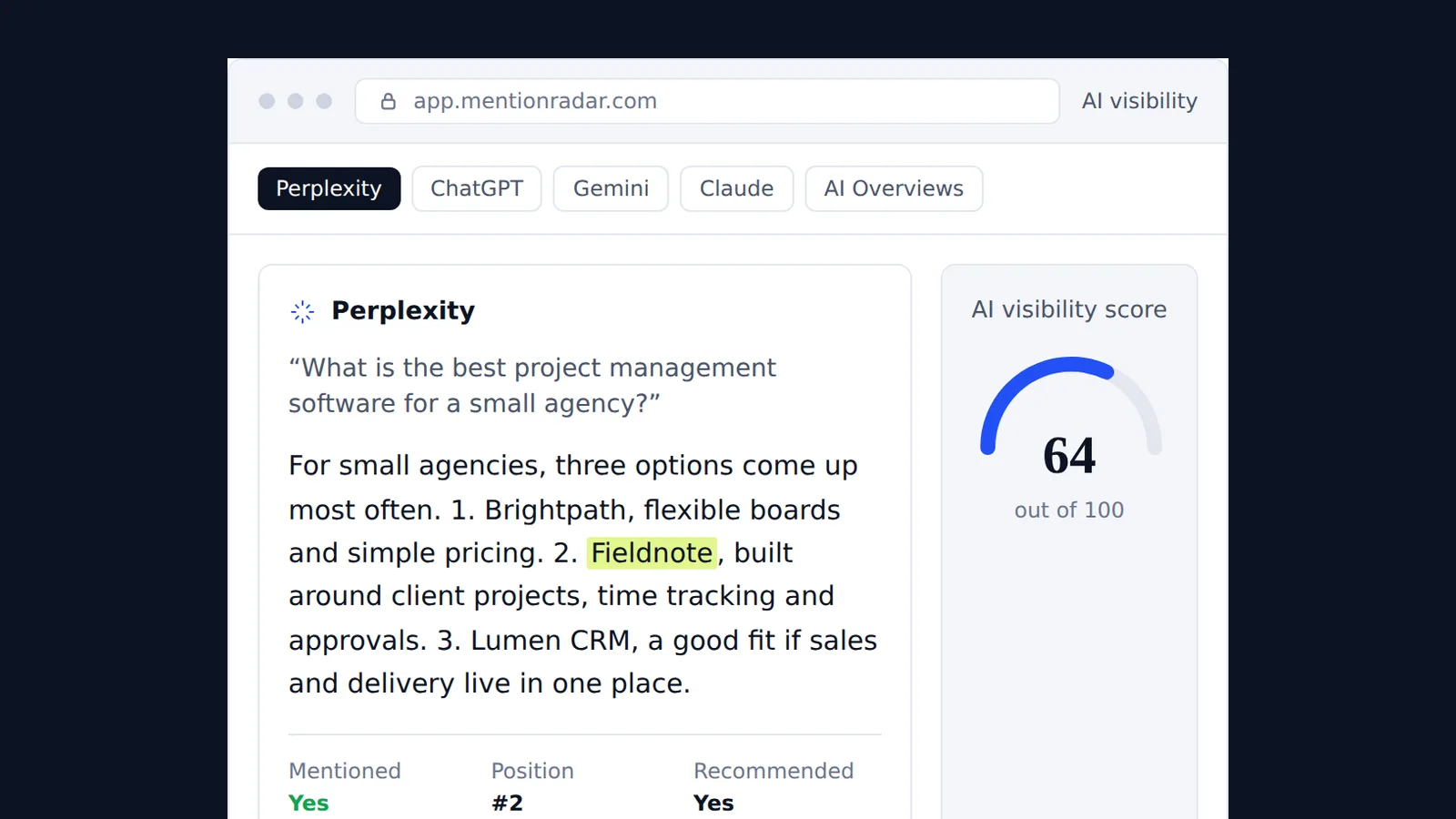
Check what AI engines and the web say about your brand
To track brand mentions in ChatGPT, Gemini and Perplexity, write the prompts your buyers really ask, run them on each engine on a fixed schedule, and record whether your brand appears, in what position, whether it is recommended, which competitors are named and which URLs the engine cites.
That is the whole method. The hard part is doing it consistently enough that the numbers mean something, because AI answers are not stable the way a search results page used to be. The same prompt can produce a different answer an hour later, on a different account, or in a different country. This guide explains why AI visibility tracking needs its own process, how to choose prompts, what to record for every answer, how often to run checks, and what to do with the results.
Why ChatGPT brand mentions matter now
When someone asks an assistant "which tool should I use to monitor our brand" or "what is the best accounting software for a five person agency", the answer usually names three to six products, often with a short reason for each. The buyer may never see a search results page or visit a comparison site. If your brand is not in that short list, you are not in the consideration set, and nothing in your web analytics will tell you, because the visit never happens.
Each engine behaves differently:
- ChatGPT answers from its trained knowledge and, when search is used, from live web results that it may cite with links.
- Perplexity is search first. Nearly every answer comes with numbered citations, which makes it the most transparent engine to analyse.
- Gemini draws on Google's index and often reflects what ranks well in classic search, though not always in the same order.
- Claude can answer from training data or with web search depending on the product surface, and tends to give more hedged recommendations.
- Google AI Overviews appear above the classic results for many informational queries and summarise several sources with links. Tracking them is covered on our AI Overview tracking page.
Because the engines differ, checking only one gives a partial picture. A brand can be a confident recommendation in Perplexity and absent from ChatGPT for the same question.
Step one, build a prompt set that mirrors real buyers
The quality of your tracking depends almost entirely on the prompts. A common mistake is to track prompts that contain your brand name ("is MentionRadar good"). Those tell you how the engine describes you once someone already knows you. They do not tell you whether the engine introduces you to people who do not.
Split your prompts into three groups.
Category prompts
Unbranded questions a buyer asks when they first look for a solution. "What is the best tool to track brand mentions on Reddit." "Which software helps agencies report AI visibility to clients." These are the most valuable prompts because they decide who gets onto the shortlist.
Comparison prompts
Questions that name you and a competitor, or ask for alternatives to a competitor. "Alternatives to Brand24 for B2B companies." "Compare X and Y for social listening." These show how the engine positions you against the products you lose deals to.
Brand prompts
Direct questions about your product. "What does MentionRadar do." "Is MentionRadar suitable for agencies." These reveal factual errors, outdated pricing or features the engine has wrong, which you can then correct at the source.
Aim for a mix of roughly two thirds category prompts and one third comparison and brand prompts. Write them in the language your buyers use, not your internal product vocabulary. Sales call notes, support tickets and the questions people ask in communities are the best raw material. Fifteen well chosen prompts beat a hundred generic ones.
Step two, decide what to record for every answer
A screenshot is not data. For each prompt, on each engine, on each run, record the same fields so you can compare over time.
| Field | What it captures | Why it matters |
|---|---|---|
| Mentioned | Yes or no | The basic visibility signal |
| Position | Order among the brands named | First and second mentions get far more attention than fifth |
| Recommended | Whether the engine actively suggests you, rather than just listing you | "Consider X" and "X is an option, though limited" are very different outcomes |
| Competitors named | Every other brand in the answer | Shows who you share the shortlist with |
| Cited URLs | The sources the engine links to | Tells you which pages and publications shape the answer |
| Sentiment of the description | How the engine characterises you | Catches negative framing early |
| Engine, date, location | Context of the run | Answers vary by engine and region |
Cited URLs are the most actionable field. If Perplexity keeps citing a comparison article on a review site that does not include you, you know exactly which page to approach. If ChatGPT cites your own documentation, you know that page is doing work and should stay accurate.
Step three, run prompts on a schedule
Because answers vary between runs, a single check is an anecdote. You need repeated runs to see a trend. Weekly is the practical default for most brands: frequent enough to catch shifts after a launch or a piece of coverage, not so frequent that you drown in noise. Run every prompt on the same day, at roughly the same time, from the same region, so that week over week differences reflect real change rather than test conditions.
Doing this by hand is possible for a handful of prompts. Open each engine in a clean session, paste each prompt, copy the answer into a spreadsheet, fill in the fields. In practice manual tracking breaks down at around ten prompts across three engines, because that is thirty answers a week to read and code. That is the point where a tracker earns its cost. Our AI rank tracker runs tracked prompts weekly and stores every field above, including cited URLs.
Step four, turn answers into a few numbers
Leadership will not read thirty AI answers. Summarise each run into a small set of metrics.
- Mention rate. The share of prompt runs in which your brand appears.
- Average position when mentioned. Lower is better.
- Recommendation rate. The share of runs where you are actively recommended.
- AI share of voice. Your mentions divided by all brand mentions across the prompt set, which puts you in context with competitors.
- Top cited domains. The ten sources engines rely on most for your category.
Combining these into one headline figure gives an AI visibility score. We explain how that score is built, and what moves it, in what an AI brand visibility score measures.
Step five, act on what you find
Tracking only pays off if it changes what you do. These are the most common findings and the usual responses.
You are missing from category answers
Look at the cited URLs for those prompts. They are usually comparison articles, community threads and review category pages. Getting accurately included in those sources is the most direct lever. Publishing a clear, factual page on your own site that answers the category question also helps, especially for engines that search live. Our generative engine optimization tool page covers the content side in more depth.
A competitor is recommended ahead of you
Read the reason the engine gives. It often repeats a phrase from a popular review or the competitor's own homepage ("best for small teams", "most affordable"). If that positioning is something you genuinely offer, make it explicit on your pages and in the places the engine cites.
The engine describes you incorrectly
Old pricing, discontinued features and wrong categories are common. Trace the error to the cited source if there is one, then correct your own pages, update your listings on review sites and make sure your documentation states the current facts plainly. Errors in trained knowledge fade more slowly than errors in live search answers, so persistence matters.
Negative framing appears
If an engine repeats a criticism, find where it comes from. Often it is a single highly visible Reddit thread or review. Responding publicly and fixing the underlying issue does more than any content tactic. Connecting the AI answer back to the web mention is exactly why we monitor both in one place; see our Reddit monitoring tool.
Common mistakes to avoid
- Tracking only branded prompts. They flatter you and hide the shortlist problem.
- Checking once and drawing conclusions. Single answers are noisy. Look at trends over several weeks.
- Testing from a logged in personal account. Personalisation and chat history can skew results. Use clean sessions.
- Ignoring citations. Mentions tell you where you stand. Citations tell you what to do about it.
- Treating every engine the same. A tactic that works in Perplexity, which cites heavily, may do little for answers built from trained knowledge.
Manual tracking versus a tracker
Manual checks are a good way to learn how engines behave and cost nothing but time. They stop scaling once you track more than a handful of prompts, because reading and coding answers takes longer each week and small copy errors creep in. A tracker runs the same prompts on schedule from consistent conditions, stores every field, keeps history for trend lines and alerts you when something notable changes, such as a competitor appearing in an answer where you used to lead. The right moment to switch is usually when the weekly check starts slipping because it takes too long.
Where to start this week
Write fifteen prompts, mostly unbranded. Run them on ChatGPT, Perplexity and one of Gemini or Google AI Overviews. Record mention, position, recommendation, competitors and cited URLs. Repeat next week on the same day. After a month you have a baseline worth showing to anyone. If you would rather see a first result in a minute, run a free scan of your brand on our homepage, which checks web mentions and asks one AI engine about you.
Frequently asked questions
Can I see how often ChatGPT mentions my brand?
There is no official report from the engines. The reliable method is to run a fixed set of buyer prompts on a schedule and record whether your brand appears in each answer, which gives you a mention rate over time.
How many prompts should I track?
Start with around fifteen well chosen prompts, mostly unbranded category questions. That is enough for a meaningful baseline and small enough to review properly. Expand once you know which topics matter.
Why do AI answers change between checks?
Answer engines generate text rather than return a fixed list, and many search the live web, so wording, order and cited sources vary between runs, accounts and regions. Repeated scheduled runs smooth out that variation.
Which AI engines should a B2B brand track?
ChatGPT, Perplexity and Google AI Overviews cover a large share of AI assisted research. Adding Gemini and Claude gives a fuller picture, especially if your buyers use Google Workspace or work in technical fields.
What is the fastest way to improve AI mentions?
Look at the URLs the engines cite for your most important prompts and work on being accurately included in those sources, while making your own pages answer the category question clearly and factually.