How to Track LLM Visibility Week by Week
Check what AI engines and the web say about your brand
To track LLM visibility week by week, fix a prompt set of real buyer questions, run it on the same AI engines on the same day each week, record mention, position, recommendation, competitors and cited URLs for every answer, then review a short scorecard weekly and act on the citations monthly.
Most teams that start tracking AI answers do it in bursts. Someone checks ChatGPT before a board meeting, finds the brand missing, panics, and then nobody looks again for two months. Burst checking produces anecdotes, not data. This guide lays out a weekly routine that takes under an hour once set up, the template for recording results, what to look at each week versus each month, and how to tell real change from noise. It works whether you track by hand or use an AI visibility tool.
Before week one, the setup
A good routine depends on decisions made once, up front, and then left alone.
Choose the engines
Pick the engines your buyers use. ChatGPT, Perplexity and Google AI Overviews cover a large part of AI assisted research. Add Gemini and Claude if your audience uses them, for example technical buyers or companies on Google Workspace. Fewer engines tracked consistently beat more engines tracked occasionally.
Write the prompt set
Write fifteen to twenty prompts. Make most of them unbranded category questions ("best tool to monitor brand mentions on Reddit for a B2B company"), add a few comparison prompts ("alternatives to competitor X for agencies") and a few branded prompts ("what does your brand do and how much does it cost"). Take wording from sales calls, support tickets and community threads. Our article on tracking brand mentions in ChatGPT, Gemini and Perplexity explains how to choose prompts that reflect real buyers.
List the competitors
Name three to ten competitors to record in every answer. Without them you cannot compute share of voice, and every number becomes harder to interpret.
Fix the conditions
Decide the weekday, the approximate time, the region and the account conditions. If you check by hand, use clean sessions without chat history or personal memory, because personalisation changes answers. Write these conditions down so anyone on the team can run the routine.
The recording template
Use one row per prompt, per engine, per week. The columns are the same every time.
| Column | What to write |
|---|---|
| Week | 2026 week 41 |
| Engine | Perplexity |
| Prompt | Best brand monitoring tool for agencies |
| Mentioned | Yes |
| Position | 3 of 5 |
| Recommended | No, listed only |
| Competitors named | Competitor A, Competitor B, Competitor C, Competitor D |
| Cited URLs | The comparison article and review category page cited |
| Description note | Accurate, mentions agency workspaces |
Fifteen prompts on three engines is forty five rows a week. That is manageable by hand for a short period, which is a good way to learn how answers behave. Beyond that, a tracker that runs prompts and fills the rows automatically saves several hours a week and removes copy errors. Our AI rank tracker stores these fields for every run.
The weekly routine, under an hour
Run or collect the answers
Run every prompt on every engine, or open the tracker's latest run. Do not skip prompts that "never change". Stability is information too.
Update the scorecard
Calculate four numbers for the week:
- Mention rate. Answers that name you divided by total answers.
- Recommendation rate. Answers that actively recommend you divided by total answers.
- Average position when mentioned.
- AI share of voice. Your appearances divided by appearances of all tracked brands.
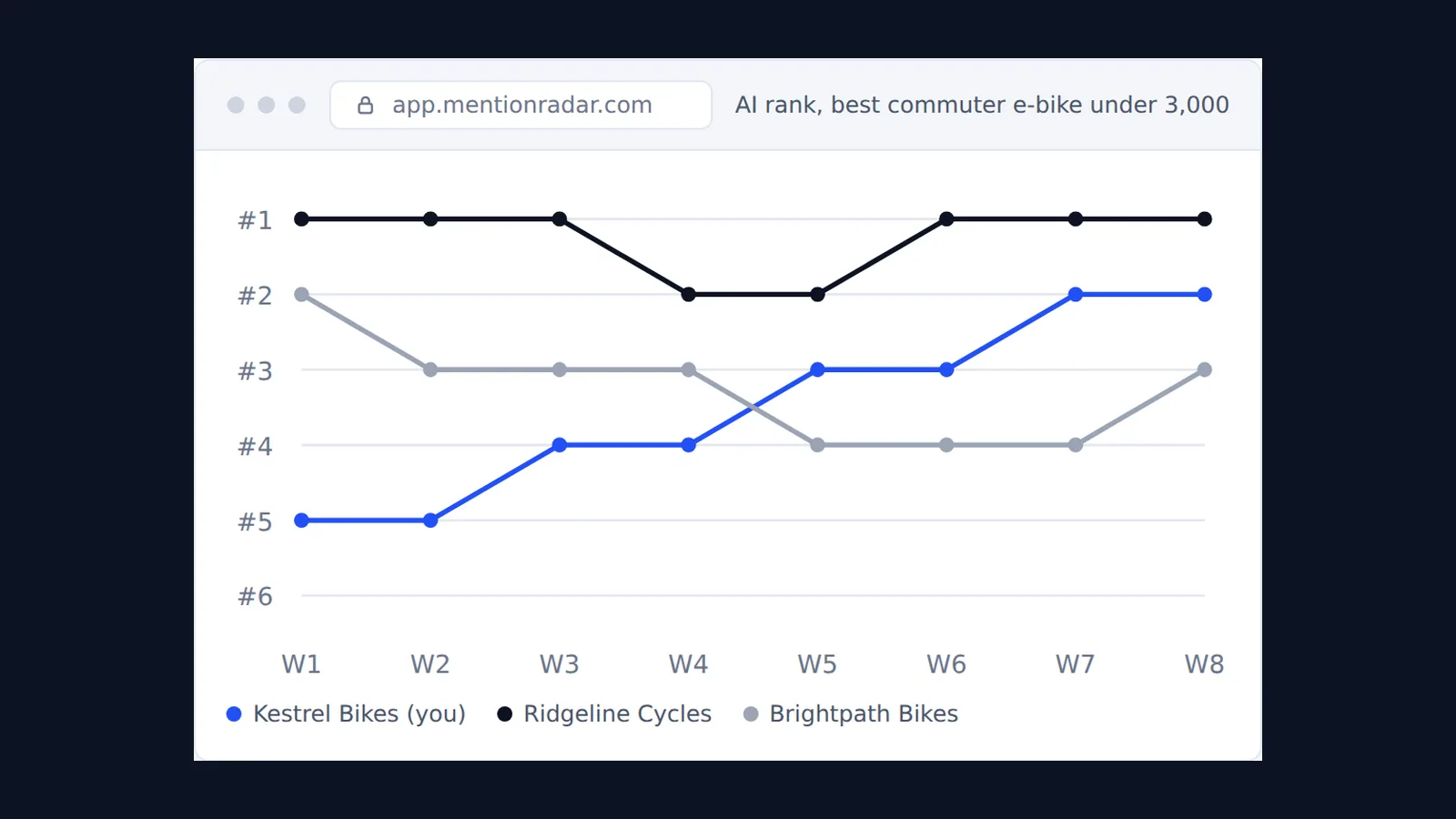
Plot each as a line with the previous weeks. Four lines on one chart is the whole weekly view. If you prefer a single figure, combine them into a score as described in what an AI brand visibility score measures.
Scan for notable changes
Look for three things: a prompt where you appeared last week and disappeared this week (or the opposite), a new competitor appearing in several answers, and any description of your brand that is wrong or negative. Write one line for each in a running log.
Share a short note
Post the chart and the log lines in a team channel. Three sentences are enough. The habit of sharing weekly keeps the topic visible without turning it into a project.
The monthly review, about two hours
Weekly numbers are noisy. Monthly is where you decide what to do.
Look at four week trends
Compare the average of the last four weeks with the four weeks before. Movements that hold across a month are more likely to be real than week to week swings.
Analyse citations
List the domains cited most across all answers for the month, and separately for the prompts where you perform worst. These are the sources shaping answers in your category. Note whether you are included and accurately described in each. This list drives most of your actions. The AEO tool page shows how cited domains are grouped by prompt.
Pick two or three actions
Examples: correct outdated pricing on a review listing that engines cite, pitch an editor of a comparison article that omits you, write a page that answers a category question your site does not cover, respond to a community thread that engines quote. Assign each action an owner and a date.
Check last month's actions
For actions completed last month, look at the prompts they were meant to affect. Engines that search live, such as Perplexity, can reflect changes within weeks. Answers that rely on trained knowledge change more slowly, so give those more time before judging.
The quarterly reset
Once a quarter, review the prompt set itself. Remove prompts that turned out to be irrelevant, add prompts for new products or use cases, and update the competitor list. Change the set only at quarter boundaries and record the change, so trend lines remain honest. This is also the moment to decide whether to add engines.
Telling signal from noise
AI answers vary from run to run. A few practical rules prevent overreaction.
- One prompt, one week, one engine is never a trend. Wait for a change to repeat or to show up across several prompts.
- Look at rates, not single answers. Mention rate across forty five answers is far more stable than any single answer.
- Annotate events. Launches, major coverage, pricing changes, site migrations and engine updates all explain movements later. Note them on the chart.
- Compare with competitors. If every tracked brand dropped the same week, the engine probably changed its answer format rather than its opinion of you.
Connecting LLM visibility to the rest of your data
LLM visibility does not live in isolation. Answer engines draw on the open web, so changes in web coverage often show up in AI answers some weeks later. Monitoring web mentions alongside AI answers lets you connect a new Reddit thread or news story with a later shift in answers. Our social listening tool and AI tracking share one dashboard for that reason, and the combined figure is explained in share of voice measurement across web and AI answers.
Who owns the routine
Visibility tracking falls between teams. SEO sees it as search, PR sees it as reputation, product marketing sees it as positioning. Without a named owner, the weekly run is the first thing skipped in a busy week. Assign one person to run the weekly routine and one decision maker to chair the monthly review. In smaller companies these are often the same person. The owner does not have to do every action, only make sure actions are assigned and checked.
It also helps to agree which team acts on which kind of finding. Missing from category answers is usually content and SEO work. Absent from a cited comparison article is PR. Negative framing that traces back to a community thread is product and support, with communications helping on the response. Writing this split down once avoids a debate every month.
Alerts between weekly runs
A weekly rhythm is right for trends, but some events should not wait for the next review. Set alerts for a few cases: your brand disappearing from your two or three most important prompts, a new competitor appearing in several answers in one run, and negative descriptions of your brand. On the web side, instant alerts for negative or high reach mentions catch the threads and stories that tend to feed AI answers later. Send these to email or a Slack channel the owner watches, and keep the rules few so they stay meaningful. See Reddit monitoring tool for how community alerts are set up.
What good looks like after three months
After a quarter of weekly runs, a working programme has a few recognisable traits. The scorecard has twelve or thirteen data points per metric, so trends are visible and small swings no longer cause alarm. The change log explains most large movements. There is a short, stable list of the domains that shape answers in your category, and you know where you stand on each. At least a few actions from the monthly reviews have been completed and checked against the prompts they targeted. And the weekly note has become routine enough that people notice when it is missing. None of this needs a large team. It needs the same steps done in the same way every week.
A first month plan
Week 1. Choose engines, write prompts, list competitors, record the first run. This is your baseline.
Week 2. Second run, first scorecard comparison, start the change log.
Week 3. Third run. Begin noting which domains appear in citations most often.
Week 4. Fourth run, then the first monthly review. Pick two actions based on citations.
After a month you have a baseline, a working routine and a short list of evidence based actions. If you want the first data point today, scan your brand from our homepage, which checks web mentions and one AI engine. Weekly tracking across all five engines starts on the Growth plan, listed on the pricing page.
Frequently asked questions
What does LLM visibility mean?
LLM visibility describes how often and how prominently large language model based assistants, such as ChatGPT, Gemini, Perplexity and Claude, mention and recommend a brand when answering relevant questions.
Why track LLM visibility weekly rather than daily?
Weekly runs give enough data points to see trends while keeping the review manageable. Daily checks add noise from answer variation without adding much decision value for most brands.
Can I track LLM visibility manually?
Yes, for a small prompt set. Fifteen prompts on three engines is about forty five answers a week to record. Beyond that, a tracker saves time and keeps the data consistent.
How long before changes show up in AI answers?
Engines that search the live web can reflect new content or coverage within weeks. Answers built mostly from trained knowledge change more slowly, sometimes over months.
What should I do when my brand disappears from an answer?
Check whether it repeats over the next runs and across engines. If it does, look at the cited URLs for that prompt to see which sources the engine now relies on, and work on accurate inclusion in those sources.